
.webp?width=350&height=54&name=2026%20Jan%20Adaptive%20Logo%20(350%20X%2054).webp "2026 Jan Adaptive Logo")

Scope modeling is one of the most criticalresponsibilities of a Business Analyst (BA). Many project failures do nothappen because of poor execution — they happen because the scope was unclear,misaligned, or poorly defined.
Scope modeling brings clarity.
It ensures that:
- We solve the right problem
- With the right solution
- Within the right boundaries
- Using the right project controls
In this blog, we’ll explore:
- The purpose of scope modeling
- The four levels of scope models
- Need Scope
- Analysis Scope
- Solution Scope
- Project Scope
- Techniques commonly used at each level
What is Scope Modeling?
Scope modeling is the structured definition ofboundaries at different levels of change — from business need toimplementation.
It answers progressively narrowing questions:
|
Level |
Core Question |
|
Need Scope |
What problem or opportunity are we addressing? |
|
Analysis Scope |
What parts of the business must change? |
|
Solution Scope |
What will the solution include (and exclude)? |
|
Project Scope |
What work will be performed to deliver it? |
Without distinguishing these levels,organizations often:
- Jump into solutioning too early
- Confuse business objectives with features
- Over-engineer
- Experience scope creep
- Deliver outputs instead of outcomes
Purpose of Scope Modeling
The primary purposes are:
1. Strategic Alignment
Ensures the initiative aligns with businessgoals and real needs.
2. Boundary Definition
Clarifies what is in scope and out of scope ateach level.
3. Stakeholder Alignment
Prevents misunderstandings between sponsors,SMEs, product owners, and project teams.
4. Risk Reduction
Avoids scope creep, gold-plating, andmisdirected effort.
5. Value Optimization
Keeps focus on outcomes rather than features.
The Four Levels of Scope Models
Scope is not one thing. It exists in layers.Let’s explore each level in depth.
1. Need Scope (Business Scope)
What is Need Scope?
Need Scope defines the business problem oropportunity boundary.
It answers:
- Why are we doing this?
- What business area is impacted?
- What outcomes are expected?
- What is outside this initiative?
It focuses on business value, notfeatures.
Key Characteristics
- Strategic level
- High abstraction
- Outcome-focused
- Independent of technology
Example
Problem: Customer churn is increasing.
Need Scope:
- Improve customer retention in the subscription business.
- Excludes pricing strategy redesign.
- Focuses on customer experience and service processes.
Common Techniques for Need Scope
1. Business Model Canvas
Helps understand value propositions, customer segments, and impact areas.
Clarifies internal and external drivers for change.
3. Root Cause Analysis (5 Whys, Fishbone)
Ensures the problem is real and not symptomatic.
4. Context Diagram (High-Level)
Shows external entities interacting with the business.
5. Problem Statement / Opportunity Statement
Clearly defines measurable objectives.
6. Stakeholder Analysis
Identifies who is impacted at a business level.
2. Analysis Scope
What is Analysis Scope?
Analysis Scope defines the portion of the enterprise to be analyzed to understand the change.
It answers:
- Which processes?
- Which business units?
- Which systems?
- Which stakeholders?
- Which data?
This is where we zoom in from business need to affected business components.
Key Characteristics
- Investigative level
- Defines analysis boundaries
- Identifies impacted domains
- Bridges strategy and solution
Example
For customer churn:
- Analyze onboarding process
- Analyze support ticket resolution workflow
- Analyze subscription cancellation journey
- Excludes marketing campaign redesign
Common Techniques for Analysis Scope
1. Process Maps (As-Is Process Modeling)
Shows current workflows and boundaries.
2. SIPOC Diagram
Defines Suppliers, Inputs, Process, Outputs, Customers.
3. Organizational Modeling
Identifies departments involved.
4. Capability Mapping
Identifies which business capabilities are impacted.
5. Data Flow Diagrams (High-Level)
Shows data movement between components.
6. Stakeholder Matrix (Detailed)
Clarifies analysis participants.
3. Solution Scope
What is Solution Scope?
Solution Scope defines what the solution will contain — and what it will not.
It answers:
- What features?
- What functionality?
- What interfaces?
- What integrations?
- What constraints?
- What assumptions?
This is where scope creep commonly begins —hence clarity is crucial.
Key Characteristics
- Feature-focused
- Product-oriented
- Technology-aware
- Defines inclusion/exclusion clearly
Example
Solution Scope:
- Implement automated churn prediction module
- Add cancellation feedback form
- Introduce proactive support alerts
- Excludes CRM replacement
- Excludes loyalty program redesign
Common Techniques for Solution Scope
1. Use Case Modeling
Defines user interactions.
2. User Stories with Acceptance Criteria
Agile feature scoping.
3. Functional Decomposition
Breaks solution into manageable components.
4. Interface Inventory
Lists external systems.
5. Feature Lists (In Scope / Out of Scope Table)
Prevents ambiguity.
6. Requirements Traceability Matrix
Links solution elements to business need.
4. Project Scope
What is Project Scope?
Project Scope defines the work required to deliver the solution.
It answers:
- What tasks will be performed?
- What deliverables?
- What timeline?
- What budget?
- What constraints?
- What dependencies?
Project scope is often confused with solution scope — but they are not the same.
Solution Scope = What will be built
Project Scope = What part of the Solution shall be built
Key Characteristics
- Execution-focused
- Time-bound
- Budget-aware
- Deliverable-driven
Example
Project Scope:
- Requirements workshops
- Development sprints
- Testing cycles
- Deployment
- Training sessions
- Documentation
- Excludes post-go-live optimization
Common Techniques for Project Scope
1. Work Breakdown Structure (WBS)
Breaks project work into deliverables.
2. Gantt Chart
Schedules execution.
3. RACI Matrix
Defines responsibility.
4. Project Charter
Formal scope authorization.
5. Sprint Backlog (Agile)
Defines short-term execution scope.
6. Risk Register
Identifies scope-related threats.
How the Four Levels Connect
The four scopes form a cascading model:
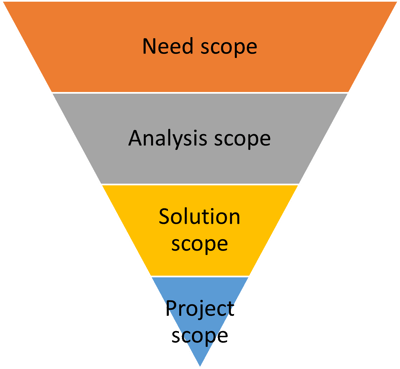
If Need Scope is wrong, everything downstream is misaligned.
If Solution Scope is unclear, the project overruns.
If Project Scope is inflated, budget explodes.
Strong Business Analysts consciously operate across all four layers — not just requirements documentation.
Common Scope Modeling Mistakes
- Jumping to solution before defining need.
- Confusing project tasks with product features.
- Ignoring out-of-scope definitions.
- Not linking solution to measurable business outcomes.
- Allowing stakeholders to redefine scope mid-project without governance.
Best Practices for Effective Scope Modeling
- Always define out-of-scope items explicitly
- Trace everything back to business objectives
- Use visual models — not just text
- Revisit scope at phase gates
- Separate solution discussions from project planning
- Validate scope with stakeholders formally
Why Scope Modeling Matters for Business Analysts
Scope modeling is not documentation — it is strategic thinking.
A strong BA:
- Protects business value
- Prevents waste
- Aligns stakeholders
- Controls complexity
- Reduces rework
- Improves delivery success
In mature organizations, scope clarity is a competitive advantage.
Final Thoughts
Scope modeling is a layered discipline.
You cannot define project work without first defining solution boundaries.
You cannot define solution boundaries without first understanding analysis scope.
You cannot define analysis scope without understanding the true business need.
When practiced correctly, scope modeling transforms Business Analysts from requirement writers into value architects.
And that is where real impact begins.

ECBA exam passing score for 2026 | Free 50 ECBA mock questions

What is CBAP exam passing score in 2026


 Contact Us
No Comments Yet
Let us know what you think